The short answer
Descale a cooling tower with an inhibited descaler containing a corrosion inhibitor, such as POWER CLEAN DE-46, which dissolves silica, carbonate, silicate and sulphate scales while protecting copper and brass. Pair it with a low-dosage biocide like SA-17 to control bacteria, algae, fungi and odour.
- Descaler
- POWER CLEAN DE-46 (SKU 503)
- Biocide
- POWER CLEAN SA-17 (SKU 915)
- Metal safety
- Multi-metal, safe on copper and brass
- Scales removed
- Silica, carbonates, silicates, sulphates
- Efficiency stake
- 3/16" fouling can cut efficiency 21% (US EPA)
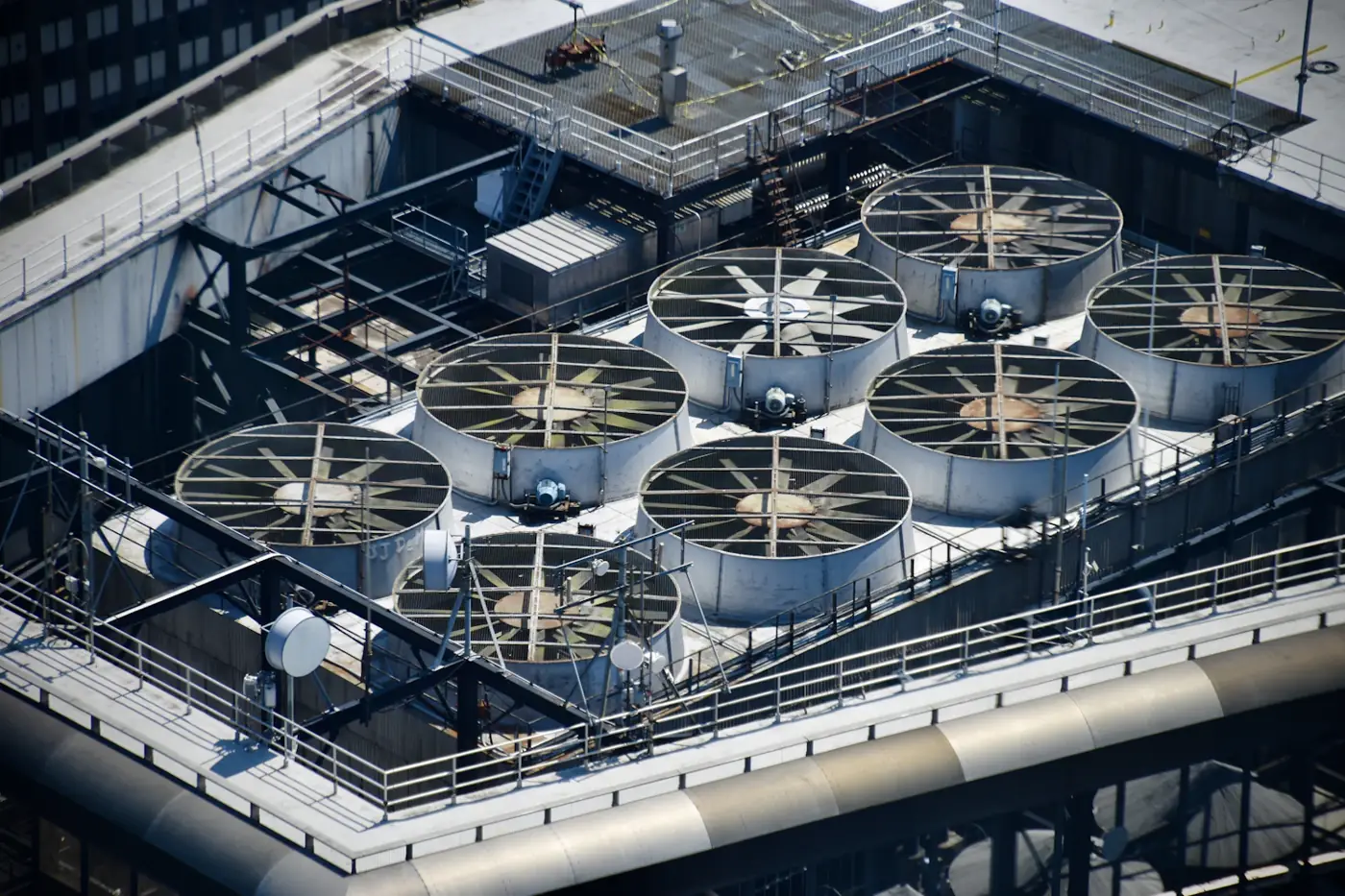
A cooling tower exists to reject heat that equipment has picked up. Everything that degrades that heat transfer costs energy directly — and scale degrades it faster than almost anything else, because a mineral layer on a heat exchange surface is an insulator.
What actually forms in the system
Cooling water concentrates as it evaporates, and dissolved minerals come out of solution on the hottest surfaces. Dirty, scale-filled basins and pipework then become a breeding ground for bacteria and fungi, which is where the foul odour around a neglected tower comes from.
- Scale deposits — silica, carbonates, silicates, and sulphate salts of calcium, magnesium and sodium
- Corrosion products from mild steel pipework and copper or brass exchanger tubes
- Biological growth — slime-forming bacteria, sulphate-reducing bacteria, algae and fungi
- Airborne dirt and dust washed into the basin from the air stream
Choosing a descaler that will not eat the system
The mistake is to use a raw acid. It removes scale efficiently and attacks the base metal along with it — a particular risk in systems with copper and brass exchanger tubing. What you want is a descaling agent with surfactants and a built-in corrosion inhibitor.
POWER CLEAN DE-46 combines a powerful descaling agent, a surfactant and corrosion inhibitors for cooling towers, chillers and heat exchangers. It dissolves scale rapidly, prevents and removes corrosion in the same operation, is safe as a multi-metal descaler including copper and brass, and is effective at low dosing.
Controlling biological growth
Descaling a system and leaving the biology untouched simply resets the clock. POWER CLEAN SA-17 is a biocide for open circulating cooling systems that controls bacteria, algae and fungi, and is effective against slime-forming and sulphate-reducing bacteria — the organisms responsible for both fouling and bad odour. It works at low dosage.
A maintenance schedule that holds
- 1Inspect the basin, fill and exchanger surfaces on a fixed cycle rather than when a problem appears.
- 2Descale with an inhibited descaler when deposit thickness starts to affect approach temperature or pressure drop.
- 3Dose biocide continuously or on a shock schedule for open circulating systems to keep biological counts down.
- 4Control blowdown so dissolved solids do not concentrate to the point where scale forms rapidly.
- 5Keep the basin free of debris and sludge, which shelters biological growth from the biocide.
- 6Record approach temperature and energy consumption — a rising trend is scale forming before you can see it.
Signs you are already losing efficiency
- Approach temperature creeping up over weeks with no change in load
- Chiller working harder for the same cooling duty, showing as higher energy consumption
- Visible white or grey deposits on fill and basin surfaces
- Foul or musty odour around the tower, indicating biological growth
- Pressure drop increasing across heat exchangers
Tell us your system volume, metallurgy and water quality — we will recommend the descaler dosage and biocide schedule for it.
Get a descaling recommendationFrequently asked questions
What chemical is used for cooling tower descaling?
An inhibited descaler containing a corrosion inhibitor. POWER CLEAN DE-46 dissolves silica, carbonate, silicate and sulphate scale in cooling towers, chillers and heat exchangers while protecting the base metal, and is safe on copper and brass.
How much efficiency does cooling tower scale cost?
A build-up of only 3/16 of an inch of fouling on coils can decrease efficiency by 21%, according to the US EPA. Because the effect is gradual, it usually shows up as rising energy consumption before anyone inspects the surfaces.
Is a descaling chemical safe for copper and brass tubes?
Only if it is inhibited. Raw acids attack copper and brass. POWER CLEAN DE-46 is formulated as a multi-metal descaler with built-in corrosion inhibitors specifically so it can be used in systems containing copper and brass.
Why does a cooling tower smell bad?
Biological growth. Warm, nutrient-rich standing water supports bacteria, algae and fungi, including slime-forming and sulphate-reducing bacteria. A biocide such as POWER CLEAN SA-17 controls the growth and removes the odour at its source.
How often should a cooling tower be descaled?
It depends on water hardness, cycles of concentration and load, so schedule by condition rather than calendar. Track approach temperature and energy use, inspect on a fixed cycle, and descale when deposits begin to affect heat transfer.